

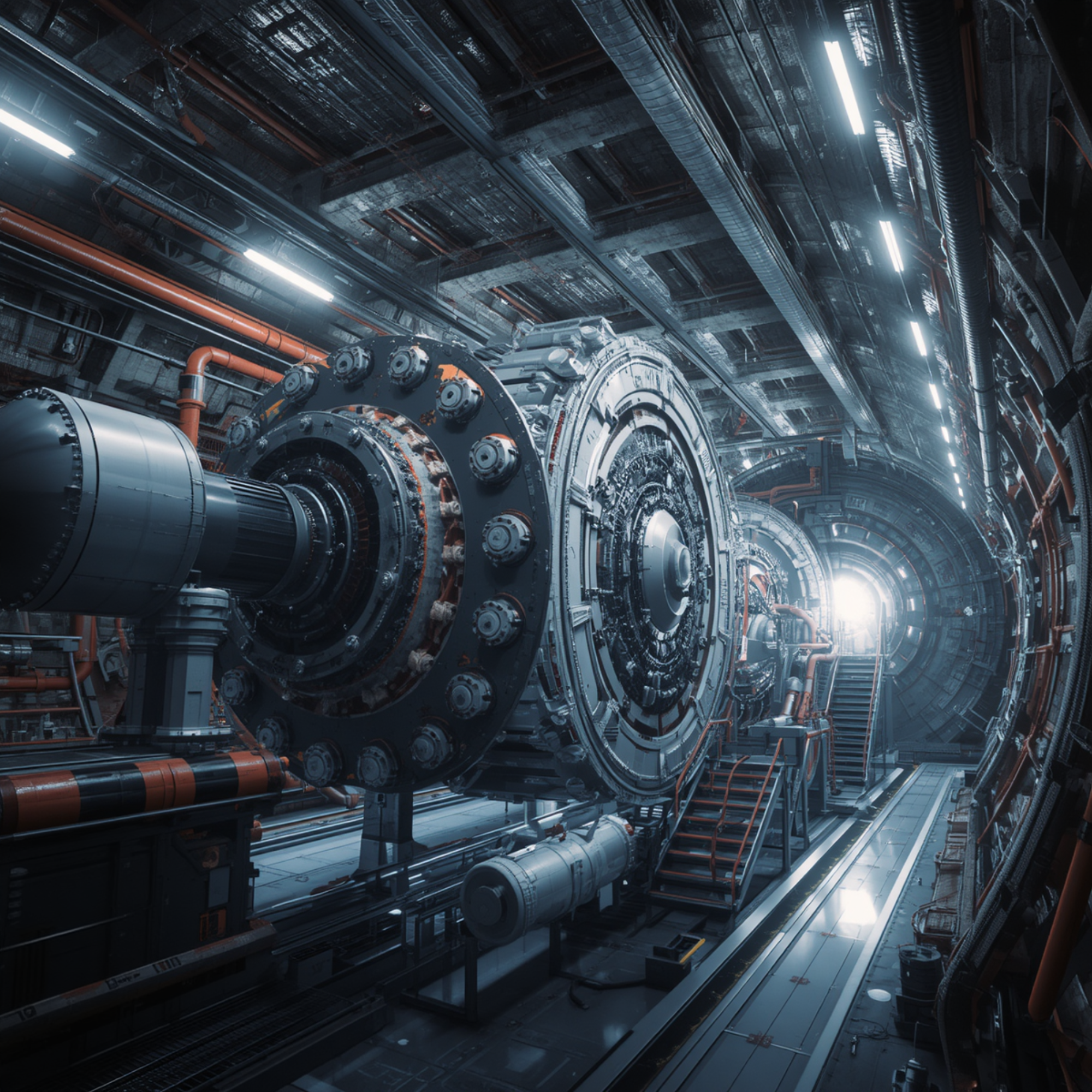
CERN is the most powerful machine ever built by humans. It is home to the Large Hadron Collider (LHC) and the global network of scientists who use its experiments to uncover the fundamental particles and forces of nature. It exists to answer some of the deepest questions in physics — What is the universe made of? Why does matter exist? What forces govern nature? This is the machine said to have discovered the God Particle.
On June 29th, the machine was shut down and went completely dark. CERN is doing a major overhaul of the LHC. And when it comes back in 2030 — it will be 10 times more powerful than it is today. The last long shutdown was in 2018; some say it could be connected to COVID back in 2019. In this article, we will discuss the origin of CERN, its purpose, and the 2026 long shutdown.

What is CERN?
CERN is the European Organization for Nuclear Research, and the institution that has been at the forefront of particle physics research. CERN was established in 1954, created in the aftermath of World War II and the desire for scientific collaboration among European nations. Located on the Franco-Swiss border near Geneva, Switzerland, CERN is home to some of the most powerful particle accelerators and instruments in the world.
The founding members of CERN aimed to promote peace and stability through scientific advancements, particularly in the field of nuclear and particle physics. The organization started with 12 member states, and over the years, it has expanded to include 23 member countries, making it a hub for international collaboration. Initially focused on nuclear research, CERN has since broadened its scope to include particle physics, exploring the fundamental constituents of matter and the universe.

The Purpose of CERN
CERN’s primary mission is to understand the fundamental structure of the universe. Researchers at CERN use particle accelerators to collide particles at incredibly high speeds, enabling researchers to study the behaviors and effects produced in the aftermath of each collision.
The Large Hadron Collider (LHC), one of CERN’s most notable projects, is the world’s largest and most powerful particle accelerator. It has made significant discoveries, including the identification of the Higgs boson in 2012, a crucial particle that helps explain why other particles have mass.
CERN’s work extends beyond fundamental physics. The organization also plays a vital role in developing cutting-edge technologies, contributing to advancements in fields such as medical imaging, data processing, and even web technology, as the World Wide Web was initially developed at CERN.

Why is CERN used?
CERN’s accelerators allow scientists to:
- Study fundamental particles — including hadrons, quarks, leptons, and rare exotic states.
- Test theories of physics — such as the Standard Model, supersymmetry, and dark‑matter hypotheses.
- Recreate early‑universe conditions — by generating extreme temperatures and densities similar to those microseconds after the Big Bang.
- Develop advanced technologies — including superconducting magnets, cryogenics, high‑performance computing, and AI‑driven data‑selection systems.
- Enable global collaboration — thousands of scientists from over 100 countries work together on experiments that no single nation could build alone.
These goals require continuous upgrades to increase collision rates, improve detector precision, and push the boundaries of what can be measured.
The 2026 Shutdown
CERN shut down the Large Hadron Collider (LHC) for several years on June, 29 2026. This decision was driven by the need to carry out major maintenance and implement critical upgrades across the accelerator and its experiments. The shutdown will allow scientists and engineers to enhance the LHC’s capabilities, ensuring it can operate efficiently and effectively for future research.
During the shutdown, CERN aims to implement improvements that will increase the luminosity of the LHC, allowing for more particle collisions and, consequently, more data collection. This upgrade is critical, opening the door for scientists to investigate new physics, examine dark matter, and deepen our understanding of the cosmos.
In addition to maintenance, the shutdown will also provide an opportunity for scientists to analyze the data collected from previous experiments. The insights gained during this time will help shape future research and experiments at CERN.
What does LS3 mean for the Future?
When the HiLumi LHC begins operation in 2030, it will deliver 140–200 collisions per bunch crossing, compared to ~60 today, dramatically expanding the scientific reach of CERN’s experiments.
This next era aims to:
- Deepen our understanding of the Higgs boson.
- Search for new particles beyond the Standard Model.
- Probe dark‑matter candidates.
- Explore extreme states of matter with unprecedented precision.

Conclusion
CERN continues to be a guiding light for international research and innovation. From its humble beginnings in the aftermath of World War II to its current status as a leader in particle physics research, CERN continues to push the boundaries of our understanding of the universe. It comes from a mix of skepticism, ethical concerns, political anxieties, and conspiracy‑driven narratives.
Some fear that CERN is manipulating weather and earthquakes, opening portals or dimensions, and could destroy the world. Scientists are describing CERN as the God particle because it allows them to give particles mass, which can fundamentally change how they behave, how they move, and how the universe itself is structured, which can be dangerous.
To learn more about the CERN shutdown, click https://www.livescience.com/physics-mathematics/particle-physics/cern-shuts-down-large-hadron-collider-until-2030-upgrading-the-atom-smasher-to-its-most-powerful-form-yet
To learn more about CERN, click https://home.cern/cern-bids-farewell-to-the-lhc-and-enters-long-shutdown-3/?utm_source=copilot.com
To read more articles from The Write Genius, click https://thewritegenius.com/blog/