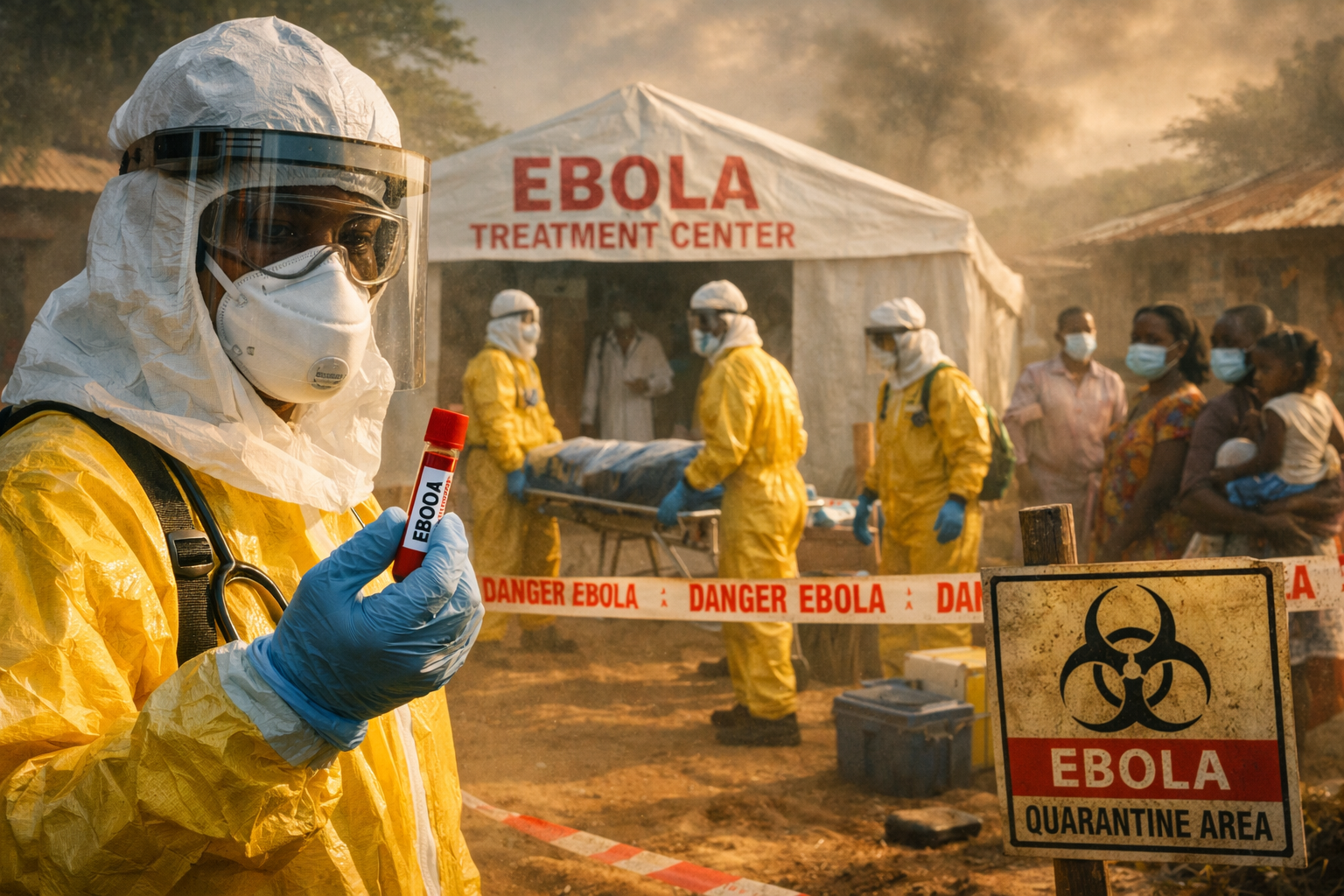
A new Ebola outbreak was confirmed in northeastern Democratic Republic of the Congo (DRC) and spread into Uganda. The outbreak was declared a public health emergency of international concern by the World Health Organization (WHO) because it has spread across borders. The Ebola outbreak has also triggered public health responses beyond Central Africa. No cases have been reported in the U.S., but the biggest concern of the Ebola virus is that there is no vaccine or treatment for the virus. The response focuses on isolating patients, tracking contacts, controlling infection, and offering supportive care.
What is Ebola?
Ebola is a severe viral illness that has a high mortality rate. The virus spreads through direct contact with blood, secretions, or other bodily fluids from an infected person or animal. The outbreak is caused by Bundibugyo virus. It is not the same as the commonly discussed Ebola virus, but the Bundibugyo virus can be severe and dangerous and is reported to kill up to 40% of infected people.
Unlike some Ebola outbreaks where vaccines and treatments exist, this outbreak is dangerous because it’s still spreading, growing larger, and is caused by a strain without any approved vaccine or treatment. Symptoms include high fever, severe fatigue, muscle and joint pain, headache, and sore throat, which can lead to internal bleeding, organ failure, confusion, and even death.

History of Ebola
Ebola was first identified in 1976 during two simultaneous outbreaks in Zaire and Sudan. These early outbreaks were severe, giving Ebola a 50‑year history marked by repeated outbreaks across Central and West Africa.
In 2014, West Africa faced the largest Ebola outbreak ever recorded, with Guinea, Liberia, and Sierra Leone hit the hardest and additional imported cases appearing in Europe and the United States. Over 28,000 cases were reported. It struck densely populated urban areas for the first time because of weak healthcare systems, slow international response, and traditional customs that unintentionally helped the disease spread faster. This outbreak changed how the world responds to epidemics and led to the development of vaccines against Ebola.
Ebola Outbreak in the DRC and Uganda?
As of mid-May 2026, the DRC is experiencing a major Ebola outbreak, driven by the Bundibugyo strain. It has become one of the largest and most complex Ebola emergencies in recent years. The Ebola outbreak report 246 suspected cases and 80 suspected deaths in Ituri Province, with two confirmed cases in Uganda linked to travel from the DRC.
The Centers for Disease Control (CDC) says the outbreak is happening in areas affected by insecurity, people being displaced, movement linked to mining, and constant cross‑border travel, all of which complicate contact tracing and isolation.

What should Americans take from this?
The most important fact for Americans is that no Ebola cases related to this outbreak have been confirmed in the United States. The CDC says the risk to the American public remains low at this time. The U.S. has taken precautions to prevent the virus from spreading and says it is also helping contain the outbreak where it began. On May 23, the State Department took swift action to contain the outbreak in the DRC to help protect Americans.
The CDC and Department of Homeland Security (DHS) announced enhanced travel screening, entry restrictions, and public‑health measures for travelers arriving from affected regions. The CDC says travelers from the DRC, South Sudan, and Uganda are being directed to certain airports, and that screening and monitoring have been increased across the country. The risk to the general public is still low.
Reports say an American who was exposed while caring for Ebola patients in the DRC was taken to Germany for treatment and is stable. The CDC added that high‑risk contacts were moved to Germany and the Czech Republic and have shown no symptoms.
The main U.S. concern right now isn’t the virus spreading here, but being prepared, screening travelers, and using border‑health measures to keep it from coming in. For the public, the immediate message is to stay calm and alert rather than panic.
Kenya’s Response to the Ebola Outbreak
On June 1, protests broke out in Kenya over a planned U.S.-funded Ebola quarantine center for Americans arriving from the Democratic Republic of Congo. The facility, located at Laikipia Air Base and equipped with 50 isolation beds, was built and staffed by U.S. medical teams. The United States pledged $13.5 million to support Kenya’s Ebola preparedness.

Meanwhile, protesters opposed to having an Ebola center in Kenya, which resulted in violent confrontations with police. A rights group said a 27‑year‑old man was shot and killed, but police and emergency services say they’ve confirmed only two injuries, not a death.
On the other hand, demonstrators opposed the idea of hosting an Ebola center on Kenyan soil, leading to violent clashes with police. A rights group reported that a 27‑year‑old man was shot and killed, though police and emergency services have not confirmed any deaths, only two injuries. President William Ruto, President of Kenya, defended the center, calling it a normal part of Kenya’s national health‑preparedness system.
Conclusion
The history of Ebola reveals a virus that has repeatedly challenged global health systems, exposed gaps in outbreak preparedness, and reshaped how countries work together. In the DRC, where Ebola was first identified in 1976, the virus has reappeared again and again, worsened by conflict, weak healthcare, and mistrust of authorities. Uganda shares open borders and constant movement with the DRC and has faced numerous spillover events. Typically, they respond with fast detection and containment efforts that set an example.
The U.S. has never had ongoing Ebola transmission, but it has handled a few imported cases and treated evacuated healthcare workers. These experiences push the country to invest heavily in biocontainment, surveillance, and global health security. Their experiences show that Ebola is not only a medical challenge but also a political, social, and logistical challenge that requires trust, teamwork, and long‑term readiness.
Sources include: https://www.cdc.gov/ebola/situation-summary/index.html)
https://www.cdc.gov/han/php/notices/han00530.html
To read more articles from The Write Genius, click here https://thewritegenius.com/blog/